
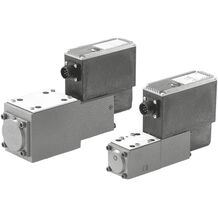
4/4 directional design
In principle, the function of these valves corresponds to the function of the 4/3-way version. With de-energized solenoid, the control spool is, however, held in a fail-safe position by a compression spring.
The 4/4 directional control valves are designed as direct operated devices in plate design. Operation is effected by means of control solenoid. The solenoid is controlled via integrated control electronics.
Set-up:
The valve basically consists of:
- Housing (1) with connection surface
- Control spool (2) in sleeve (3) with compression springs (4)
- Solenoid (5) and cover (6)
- Position transducer (7)
- Integrated control electronics (8)
- Zero point adjustment accessible via Pg9 (9)
Functional description:
- With de-energized solenoid (5), fail-safe position of the control spool (2) by compression spring (4)
- Direct operation of the control spool (2) by energization of a control solenoid (5)
e.g. control of the solenoid
- Displacement of the control spool (2) proportionally to the electric input signal
- Connection from P to A and B to T via orifice-type cross-sections with continuous or inflected linear flow characteristics
- Switching off the solenoid (5)
- The compression spring (4) brings the control spool (2) back into the fail-safe position
The 4/3 and 4/4 directional control valves are designed as direct operated devices in plate design. Operation is effected by means of control solenoids. The solenoids are controlled via integrated control electronics.
Set-up:
The valve basically consists of:
- Housing (1) with connection surface
- Control spool (2) in sleeve (3) with compression springs (4 and 5)
- Solenoids (6 and 7)
- Position transducer (8)
- Integrated control electronics (9)
- Zero point adjustment (10) accessible via Pg9
Functional description:
4/3 directional design
- With de-energized solenoids (6 and 7), mechanical central position of the control spool (2) by compression springs (4 and 5)
- Direct operation of the control spool (2) by energization of a control solenoid
e.g. control solenoid “b” (7)
- Displacement of the control spool (2) to the left, proportionally to the electric input signal
- Connection from P to A and B to T via orifice-type cross-sections with continuous or inflected linear flow characteristics
- Switching off the solenoid (7)
- The compression spring (4) brings the control spool (2) back into the central position
In the de-energized condition, the control spool (2) is held in a mechanical central position by the control springs. This position does not correspond to the hydraulic central position!
When the electric valve control loop is closed and with command value presetting 0 (0 V with A1 and/or 12 mA with F1), the control spool (2) is positioned in the hydraulic central position.